The Street Level Power of Bus Stop Advertising
Bus stop advertising works because it meets people where they already are. On pavements, high streets, residential roads and commuter routes, bus shelters sit directly in the flow of everyday life. People do not rush past them. They wait beside them, stand under them, and return to them day after day.
That physical pause creates one of the longest dwell times in out of home advertising. Unlike roadside billboards or moving formats, shelter panels are viewed at close range, often for several minutes at a time. This makes bus stop advertising uniquely suited to bold creative ideas that benefit from attention rather than speed.
When Brands Use the Shelter as a Canvas
The most effective bus stop campaigns do not treat the shelter as just another poster site. They treat it as a structure that can be transformed. When brands think beyond the flat panel, bus stop advertising becomes something people talk about rather than simply notice.
Because shelters exist at eye level and within arm’s reach, they are ideal for creative that feels physical, playful and unexpected. This is where the medium really separates itself from other out of home formats.
BuzzBallz and the Power of Going Literal
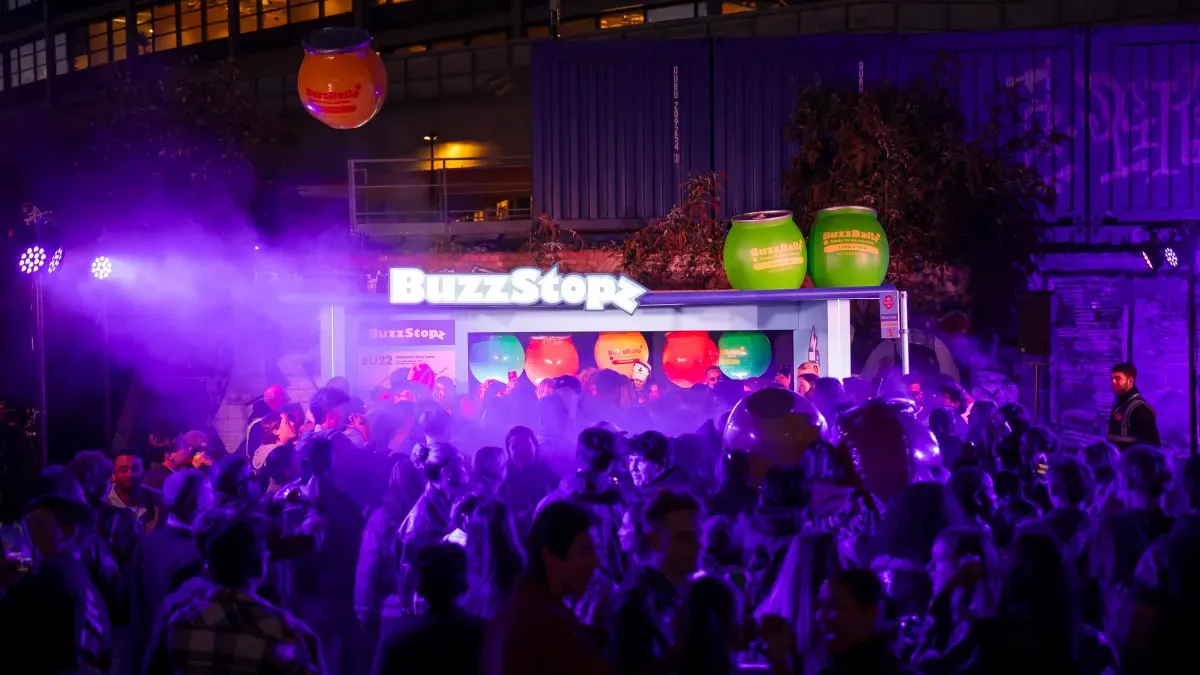
The BuzzBallz campaign is a perfect example of how bus stop advertising can deliver cultural cut through when brands fully commit to the format. Rather than relying solely on printed creative, BuzzBallz installed giant, three-dimensional replicas of its product directly on top of bus shelters.
These oversized spherical structures were impossible to miss. They turned ordinary bus stops into landmarks, catching attention from pedestrians, drivers, and waiting passengers alike. The execution worked because it was literal, confident and unapologetic. A BuzzBall looked exactly like a BuzzBall, just at an absurd scale.
By repeating this execution across multiple locations, the brand created a sense of domination. Even people who did not stop at the shelters could not avoid seeing them. For those waiting underneath, the experience was immersive, memorable, and instantly shareable.
This is where bus stop advertising excels. It allows brands to turn functional street furniture into something that feels playful and disruptive without being intrusive.
Why Dwell Time Makes Creative Stick
Bus shelters give brands time. People waiting for buses are not glancing for a second and moving on. They are standing still, often looking directly at the structure in front of them. This allows creative ideas like 3D builds, physical extensions and bold visual statements to land properly.
In the case of BuzzBallz, the longer someone waited, the more the execution worked. The scale, humour and confidence of the build reinforced brand recall rather than wearing thin. That kind of sustained attention is difficult to achieve in many other media environments.
A Medium That Balances Scale and Local Presence
Bus stop advertising also offers a rare balance between mass reach and neighbourhood relevance. Shelters are distributed across cities rather than concentrated in a single area. This means brands can achieve broad coverage while still appearing rooted in local streets and communities.
For large consumer brands, this creates a feeling of ubiquity. For audiences, it makes the brand feel part of their everyday environment rather than something distant or abstract. When combined with standout creative, this presence becomes hard to ignore.
Why Bus Stop Advertising Continues to Stand Out
Campaigns like BuzzBallz show that bus stop advertising is at its most powerful when brands embrace the physical nature of the medium. Shelters are not just frames for posters. They are structures that can be used to surprise, entertain and dominate space in a way that feels human and tangible.
As audiences become harder to reach through traditional channels, bus stop advertising continues to deliver attention, memorability and real-world impact. When brands are willing to think bigger and bolder, the humble bus shelter can become one of the most effective stages in out of home advertising.